OPENING HOURS
Dinner à La Carte 18.00 hrs. – 23.00 hrs.
OPEN EVERY DAY
 English
  Deutsch
  Français
  ไทย
ไทย  한국어
한국어 
Casa pascal is famous for its European and Thai cuisine. In the heart of Pattaya. Elegant, yet casual
Casa Pascal
Pattaya 2nd Road
Opposite Royal Garden Plaza
Tel. +66 (0)61 643 99 69
GPS: 12.928697, 100.879844
Contact Us
RESERVATION
Online reservations submitted after 18:00 hrs. for the same evening might not be granted.
For a reservation tonight, please call +66 (0)61 643 99 69
Casa Pascal's beef fillet tartare
Casa Pascal's beef fillet tartare
Tatar or Tartar? Origin, History and Correct Spelling
The words Tatar, Tartar and Tartare look almost identical, yet their linguistic history is surprisingly complex. It is essential to distinguish between the original name of an Inner Asian people, its medieval European transformation and its later culinary use.
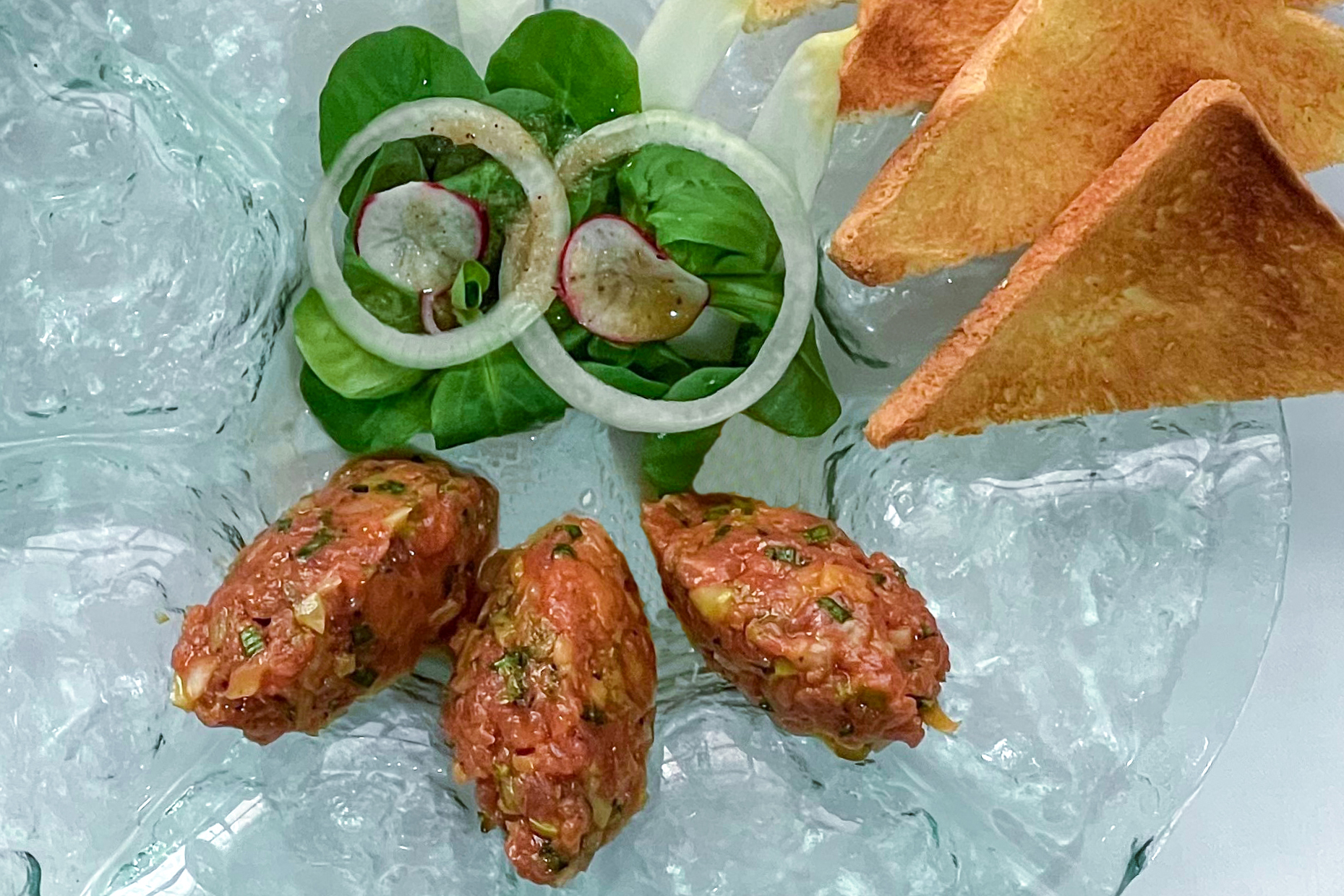
Beef Tatar
1. The Original Name: Tatar
The name Tatar is neither European nor originally Latin. It comes from Inner Asia and initially referred to particular tribal groups or confederations in the region of present-day Mongolia.
Among the earliest clear written records are the Old Turkic Orkhon inscriptions from the eighth century. The inscriptions dedicated to Kül Tigin and Bilge Qaghan, dating from 732 and 735, mention groups called:
- Otuz Tatar – the “Thirty Tatars”
- Toquz Tatar – the “Nine Tatars”
These records prove that the form Tatar, without a second r, existed several centuries before the Mongol Empire and before sustained contact with Western Europe.
It is not known who originally created the name. The inscriptions merely show that it was already established by that time.
2. Tatars and Mongols Were Not Originally the Same People
The historical Tatars were initially a separate tribal confederation and, for a time, enemies of the Mongols.
Around 1202, Temüjin, the future Genghis Khan, defeated the Tatars. Some of the survivors were incorporated into his state and military forces. In 1206, Temüjin was proclaimed Genghis Khan and founded the Mongol Empire.
The empire did not call itself the “Tatar Empire”. Its rulers and peoples identified themselves as Mongols.
3. Why Were the Mongols Nevertheless Called Tatars?
As Mongol armies advanced westwards during the early thirteenth century, neighbouring peoples increasingly used the already familiar name Tatar as a collective designation for the new conquerors.
Some actual Tatars had been absorbed into the Mongol armies. Furthermore, the name Tatar was already known among certain neighbouring peoples, whereas the name Mongol was still unfamiliar in much of Europe.
There was therefore no single person who officially gave the Mongols the name “Tatars”. The designation developed gradually as an exonym and spread through Asian, Russian, Caucasian and eventually Western European sources.
One particularly famous source is the account of the papal envoy Giovanni da Pian del Carpine, who travelled to the court of the Great Khan between 1245 and 1247.
The traditional title of his work reads:
Historia Mongalorum quos nos Tartaros appellamus
Meaning:
“History of the Mongols whom we call Tatars.”
The word “we” is crucial. Giovanni did not claim that these people called themselves Tatars. He stated that Western Europeans called them by that name.
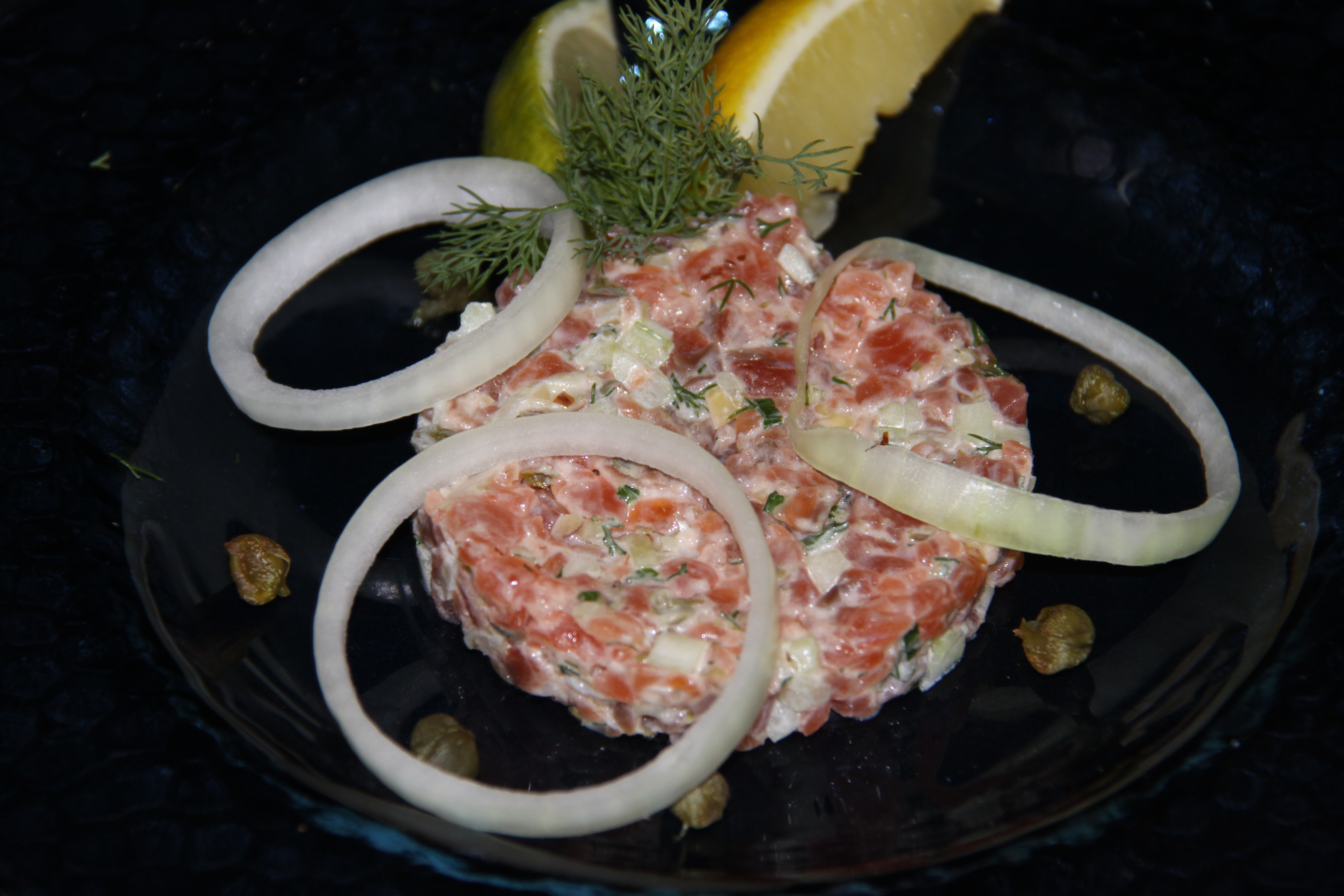
Beef Tatar
4. Where Did the Additional r Come From?
In Latin-speaking Western Europe, Tatar gradually became Tartar, with Latin forms such as Tartari and Tartarus.
The additional r arose through association with a much older word:
- Greek: Tártaros
- Latin: Tartarus
In Greek and Roman mythology, Tartarus was the deepest part of the underworld, associated with punishment, damnation and terror.
When the Mongol armies threatened Europe in the thirteenth century, medieval chroniclers connected the unfamiliar name Tatar with the familiar word Tartarus. Linguistically and symbolically, the feared invaders were thus portrayed as people emerging from Tartarus—from hell or the underworld.
The additional r was therefore not part of the original ethnic name. It resulted from a medieval Western European reinterpretation.
5. Why the Greater Age of the Latin Word Proves Nothing
The Latin word Tartarus is indeed much older than the modern German spelling Tatar. This does not mean, however, that Tartar is the original or more correct form of the ethnic name.
They were originally two separate words:
- Tartarus referred to the mythological underworld.
- Tatar referred to peoples of Inner Asia.
Only in medieval Europe were the two words associated with one another. Tatar did not develop from Tartarus. Rather, Tatar was transformed into Tartar under the influence of Tartarus.
6. Development in French
French retained the medieval Western form containing the additional r:
- tartare
- à la tartare
- sauce tartare
- steak tartare
The culinary expression sauce à la tartare appeared in French cookery books in the early nineteenth century. Later, raw seasoned beef became known as steak tartare.
French therefore preserved the historical Western European form influenced by the Latin word Tartarus.
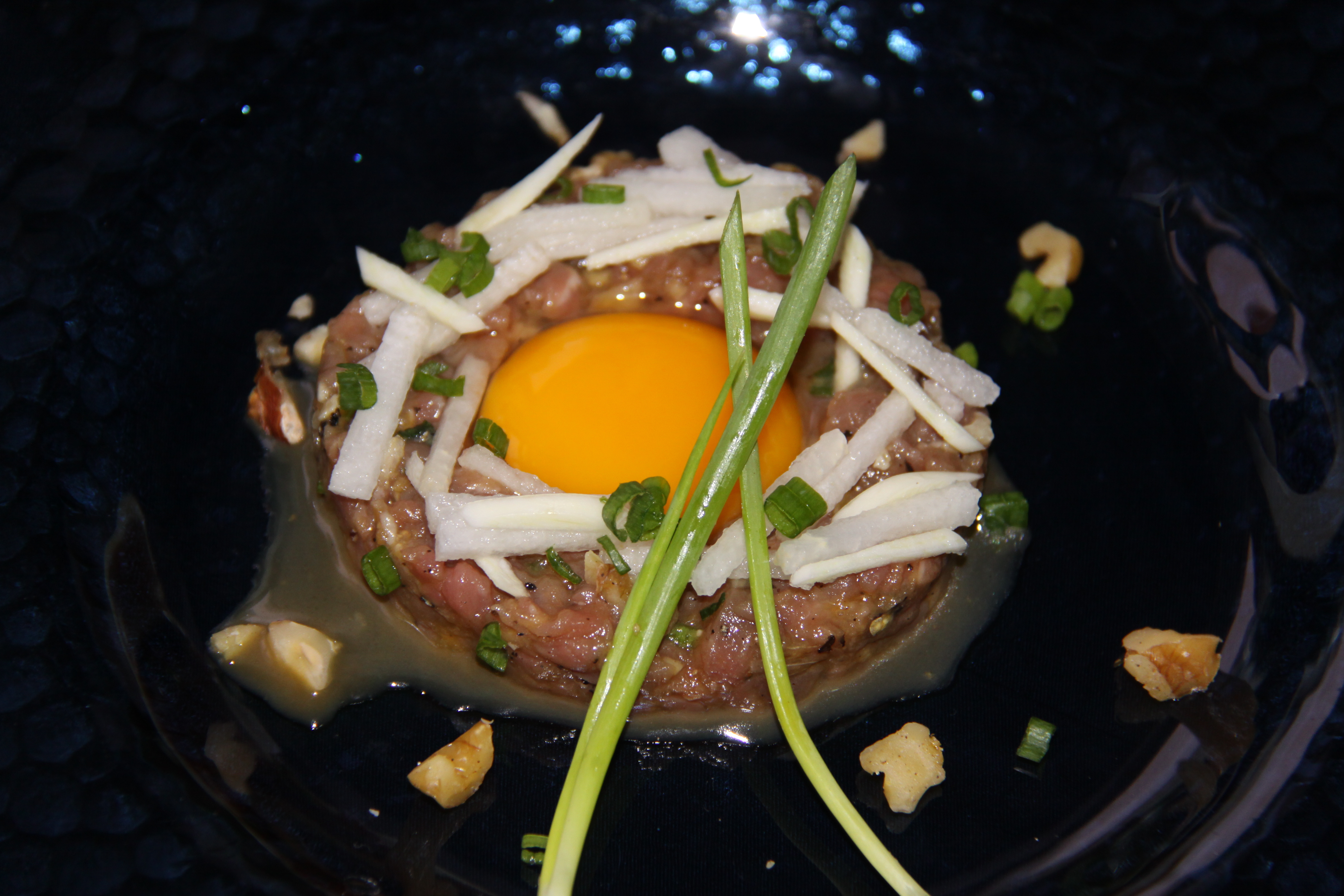
Beef Tatar
7. Development in English
English adopted the culinary terms mainly through French, but today uses two different forms:
- steak tartare
- tartar sauce
In steak tartare, the French spelling was retained.
In tartar sauce, the French expression sauce tartare was adapted to English word order and spelling.
8. The Modern German Spelling
In modern standard German, the correct forms are:
- Tatar
- Tataren
- Rindstatar
- Lachstatar
- Thunfischtatar
- Tatarensoße or, in Switzerland, Tatarensauce
The German dictionary Duden lists Tatar as the standard spelling both for the ethnic name and for the raw meat preparation. Tartar is regarded as an incorrect spelling in German.
German therefore did not arbitrarily remove an r. The German form Tatar corresponds to the original Inner Asian name before its medieval association with the Latin Tartarus.
9. Correct Forms on a Multilingual Menu
Each language now follows its own established linguistic and culinary tradition.
German
- Rindstatar
- Lachstatar
- Tatarensauce or Sauce tartare
French
- tartare de bœuf
- tartare de saumon
- sauce tartare
English
- beef tartare or steak tartare
- salmon tartare
- tartar sauce
On an elegant Swiss menu, the French expression Sauce tartare is entirely appropriate, even within a German dish description.
Example:
Kabeljau-Knusperli mit Sauce tartare
In English:
Crispy Cod Bites with Tartar Sauce
Conclusion
The original form is Tatar. It is documented in Inner Asian sources from as early as the eighth century.
During the early thirteenth century, the name was applied as a foreign designation to the Mongol conquerors. Western European chroniclers subsequently associated it with the Greek and Latin word Tartarus, meaning the underworld. This produced the medieval forms Tartar and Tartare.
The modern differences are therefore:
- German: Tatar
- French: tartare
- English: steak tartare, but tartar sauce
Historically, German did not simply “forget” an r. The second r was added later in Western Europe through a medieval reinterpretation of the older name Tatar.
Related Pages
-

153836 views Best BBQ Breakfast- & BBQ Lunch Buffet in Pattaya
The best and most popular BBQ Breakfast - & BBQ Lunch Buffet in Pattaya – at an unbelievable value... [Read More] -
139961 views Set Menus
... [Read More]